Review · Small Spaces
Best railing planters for balconies: no-drill picks by railing type
A railing planter turns the one surface every balcony has into growing space, without taking any floor. The catch is that almost every planter is designed for one railing profile, and a bracket made for a round tube will not sit on a flat cap rail. This review sorts the options by railing type, compares six designs on fit, wind, weight and drainage, and explains what to check before you buy.
 CarstenGrows everything in pots
Updated 23 Aug 2026
5 min read
Compared on design and specifications
CarstenGrows everything in pots
Updated 23 Aug 2026
5 min read
Compared on design and specifications
The links below are affiliate links: if you buy through one I earn a small commission, which costs you nothing extra and does not affect the rankings. How recommendations are made.
Top picks
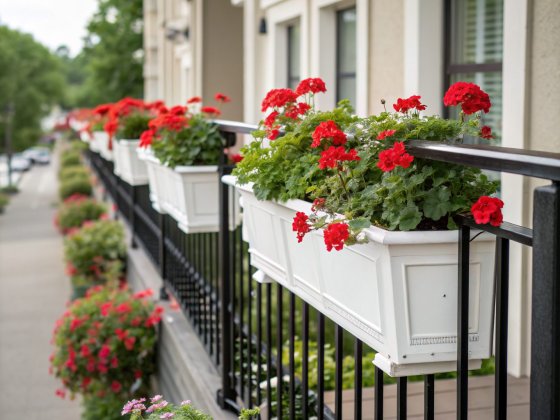
Adjustable straddle railing planter, 24 in
Round, square or flat rails from about 2 to 6 inches wide, rented or owned
- Rating
- 4.6
- Fits rail
- 2–6 in, any profile
- Material
- UV-stable polypropylene
A saddle-shaped base with sliding brackets that clamp to the rail width, so the planter sits balanced over the top with no screws and no marks. Balanced load on both sides is what survives wind. Fits more railing types than any other design.
Check price
Bloem Deck Rail Planter, 24 in
Wooden deck and balcony rails with a flat 2x4 or 2x6 cap
- Rating
- 4.4
- Fits rail
- Flat 2x4 and 2x6 caps
- Material
- Recycled plastic
A molded notch on the underside drops over a standard flat rail and sits level with nothing to adjust. Deep enough for herbs and lettuce, with a drainage tray. The simplest option if your rail is a flat board.
Check price
Self-watering railing planter with reservoir, 24 in
Hot, windy balconies where a trough dries out in a day
- Rating
- 4.3
- Fits rail
- Varies; check bracket type
- Material
- Plastic, double-wall
A false floor over a water reservoir wicks moisture up to the roots and stretches watering to every few days even in summer. On an exposed balcony, that is the difference between a railing of herbs and a railing of dry sticks.
Check priceAll 6, side by side
Compared on railing fit, material, capacity, wind behavior and drainage, from manufacturer specifications.
| Planter | Best for | Capacity | Material | Fits rail | Score | |
|---|---|---|---|---|---|---|
| Adjustable straddle planter | Any rail 2–6 in; renters | 3 gal | Polypropylene | Round, square, flat | 4.6 | Price |
| Bloem Deck Rail Planter | Flat wooden 2x4 / 2x6 rails | 2.5 gal | Recycled plastic | Flat caps only | 4.4 | Price |
| Self-watering railing planter | Hot, windy, or away often | 3 gal + reservoir | Double-wall plastic | Model-specific | 4.3 | Price |
| Metal bracket planter, coco liner | Looks; light herbs and flowers | 2 gal | Steel + coir | Round or square, fixed size | 3.8 | |
| Hook-over hanging pots | Single plants, small rails | 1 gal each | Plastic or metal | Rails under 2 in | 3.6 | |
| Single-sided screw-on bracket not picked | — | 3 gal | Steel bracket | Needs screws | 2.7 |
Measure before you read any further
Almost every one-star review of a railing planter says the same thing: it did not fit. Planters are built around a railing profile, and the profiles vary more than people expect. Before buying anything, measure three things:
- Width of the top rail. A round steel tube is often 1.5 to 2 inches. A square aluminum rail is usually 2 to 3 inches. A flat wooden cap is 3.5 inches (a 2x4) or 5.5 inches (a 2x6). Masonry parapets can be 8 inches or more.
- Shape. Round, square or flat. A bracket molded for a flat board will rock on a tube; a hook sized for a tube will not reach around a board.
- What is under the rail. Straddle planters need clear space on both sides of the rail. A rail set into a solid panel or a wall only takes hook-over or bracket designs on the open side.
With those three numbers, most of the choices below sort themselves.
The four designs
Straddle (saddle) planters have a base shaped to sit over the rail with the weight balanced on both sides, usually with sliding or clamping brackets that adjust to the rail width. They fit the widest range of rails, they stay put in wind because the load is centered, and they need no fixings. They lose an inch or two of planting depth to the saddle.
Hook-over planters hang from the rail on a pair of molded hooks or a notch, with the trough on one side. They are cheap, simple and quick to remove, and they suit flat wooden rails well. On a round or narrow rail, the hooks can rock, and a single-sided load catches wind.
Bracket planters use metal brackets that clip or screw to the rail and hold a liner or trough. Coco-lined steel ones look the best of the group and suit flowers and light herbs. Screw-on versions need holes in the rail, which rules them out for most renters and most metal railings.
Hanging pots hook individually over the rail and hold one plant each. They are flexible and cheap, suit narrow rails, and are the easiest way to add a few herbs. They dry out fastest and hold the least.
Wind, weight and the balcony below
A 24-inch trough full of wet potting mix weighs around 25 to 30 pounds and presents a broad face to the wind. Two things keep it where it belongs.
Balance the load over the rail. A straddle planter with equal weight on both sides is very hard to tip. A single-sided planter hanging off the outside of the rail is a lever, and a gust lifts it. If you must use a single-sided design, hang it on the inside of the rail, over the balcony floor, and add a tie.
Keep it low and dense. Compact, bushy plants catch less wind than tall ones. Herbs, lettuce, trailing tomatoes, nasturtiums and strawberries all suit a railing; a 4-foot pepper plant does not.
Drainage is the other neighbor problem. Water running out of a railing planter lands on whoever is below, and in many buildings that is the fastest way to a complaint. Choose a planter with a built-in tray or reservoir, water slowly until the tray is just wet rather than overflowing, and if the planter has open holes, add a drip tray or a liner with a few inches of reservoir at the bottom.
Lease and building rules
Most leases and many building rules allow freestanding containers and forbid anything fixed to the structure. All three picks above are no-drill and lift off in seconds, which keeps you inside those rules and leaves no mark when you move out. It is worth checking whether your building has a rule about planters on the outside of the rail; some require everything to hang inward, and a straddle planter satisfies either rule.
What to grow in a railing planter
A 24-inch planter holds about 3 gallons of mix, which is plenty for herbs and salad and enough for a couple of compact fruiting plants.
| Good in a railing planter | Why |
|---|---|
| Cut-and-come-again lettuce, arugula, spinach | Shallow roots, quick, happy with part sun |
| Chives, parsley, thyme, oregano, mint (alone) | Compact, productive, within reach of the kitchen |
| Tumbling Tom tomato | Bred to trail; one plant per 24-inch trough |
| Strawberries, 3 per planter | Fruit hangs over the edge, clean and out of reach of slugs |
| Nasturtiums, trailing petunias, lobelia | Color that trails down rather than standing up into the wind |
| Bush beans, 6 per planter | A real crop in a small space; keep picking |
Water daily in summer. Railing planters are exposed on every side and dry faster than a pot on the floor, which is why the self-watering option is worth its price on a sunny balcony.
Setting one up
- Measure the rail and check the planter's stated range before ordering.
- Fit the planter to the rail empty, adjust the brackets until it sits level and does not rock, and tighten.
- Put a layer of landscape fabric over any drainage holes so mix does not wash out onto the balcony below.
- Fill with potting mix to an inch below the rim, mixing in a little slow-release fertilizer.
- Plant, water gently until the tray is just wet, and check the next morning that nothing has dripped.
1. Adjustable straddle railing planter, 24 in — best overall
- Capacity
- about 3 gal
- Fits rail
- 2–6 in, any profile
- Material
- UV-stable polypropylene
- Score
- 4.6 / 5
A saddle-shaped base with sliding brackets that clamp to the rail width, so the planter sits balanced over the top with no screws and no marks. Balanced load on both sides is what survives wind. Fits more railing types than any other design. Best for round, square or flat rails from about 2 to 6 inches wide, rented or owned.
What's good
- Fits round, square and flat rails
- Load balanced over the rail, so it stays put in wind
- No drilling; lifts off in seconds
What's less good
- The saddle takes an inch or two of planting depth
- Check the maximum rail width before ordering
2. Bloem Deck Rail Planter, 24 in — best for flat rails
- Capacity
- about 2.5 gal
- Fits rail
- Flat 2x4 and 2x6 caps
- Material
- Recycled plastic
- Score
- 4.4 / 5
A molded notch on the underside drops over a standard flat rail and sits level with nothing to adjust. Deep enough for herbs and lettuce, with a drainage tray. The simplest option if your rail is a flat board. Best for wooden deck and balcony rails with a flat 2x4 or 2x6 cap.
What's good
- Nothing to adjust; drops on and sits level
- Inexpensive and widely stocked
- Built-in drainage tray
What's less good
- Flat wooden rails only
- Lightweight; add a tie in very windy spots
3. Self-watering railing planter with reservoir, 24 in — best self-watering
- Capacity
- about 3 gal + reservoir
- Fits rail
- Varies; check bracket type
- Material
- Plastic, double-wall
- Score
- 4.3 / 5
A false floor over a water reservoir wicks moisture up to the roots and stretches watering to every few days even in summer. On an exposed balcony, that is the difference between a railing of herbs and a railing of dry sticks. Best for hot, windy balconies where a trough dries out in a day.
What's good
- Several days between waterings
- Overflow hole stops the reservoir flooding
- Good for renters who travel
What's less good
- Heavier when full; check your rail
- Bracket fit varies by model, so measure first
Ones I wouldn't recommend
Single-sided screw-on brackets hang the full weight of a wet trough off one side of the rail and need screws into it, which most leases forbid and most railings are not meant for. The same bracket that holds a dry planter in May is the one that works loose under 30 pounds of wet mix in a July gust. A straddle design carries the load over the rail and needs no fixings; it is safer for the rail, the planter, and whoever is underneath.
Quick answer
Measure your railing first: its width, its shape (round, square or flat), and whether it is wood or metal. For most rails, an adjustable straddle planter that clamps over the top with sliding brackets is the best choice: it fits round, square and flat rails from 2 to 6 inches, balances the weight over the rail, and needs no screws. For a flat wooden deck rail, the Bloem Deck Rail Planter drops on and sits level. On a hot, windy balcony, a self-watering design saves the plants.
Worth knowing
If your railing is an unusual width, a wide masonry parapet, or a glass panel with a thin metal cap, a railing planter may not be the answer at all. A narrow freestanding trough on the balcony floor against the railing, or a tiered stand, does the same job without depending on the rail.
Common questions
Will a railing planter fit my balcony rail?
Measure the width and shape of the top rail first. Adjustable straddle planters fit most round, square and flat rails from 2 to 6 inches. Fixed-notch planters fit one size only, usually a flat 2x4 or 2x6.
Can I use a railing planter without drilling?
Yes. Straddle, hook-over and clip-on designs need no screws and lift straight off. Only screw-on bracket planters need holes, and most leases rule those out.
How do I stop water dripping onto the balcony below?
Choose a planter with a drip tray or reservoir, line open drainage holes with landscape fabric, and water slowly until the tray is just wet rather than until it overflows.
How heavy is a railing planter when full?
A 24-inch trough holds about 3 gallons of mix and weighs 25 to 30 pounds watered. That is fine for almost any railing as long as the load is balanced over the top rather than hung off one side.
Which railing planter is best for wind?
A straddle design with the weight centered over the rail. Single-sided planters act as a lever in a gust; if you use one, hang it on the inside of the rail and add a tie.