Listicle · Vegetables
30 best vegetables to grow in buckets (with bucket sizes)
A food-safe 5-gallon bucket costs a few dollars, holds enough mix for most crops, and lasts for years. Here are 30 vegetables ranked by how well they do in one, with the number of plants per bucket, the depth they need, and which ones do better with a second bucket or a bigger container.
- Container
- 5 gal standard
- Drill 6–8 half-inch holes in the base
- Sun
- Mixed
- Each crop lists its hours below
- Cost per pot
- About $4
- Bakeries and delis often give used ones away
- Water
- Daily in summer
- Buckets dry faster than wider pots

Quick answer
The best crops for a single 5-gallon bucket are bush tomatoes, peppers, bush beans, chard, lettuce, kale, bush cucumbers and herbs. Potatoes, zucchini and squash do better with a 10-gallon container or two buckets joined. Corn, melons and asparagus want more room than any bucket gives. Drill six to eight drainage holes in the base, fill with potting mix, and keep a light-colored bucket out of the hottest sun.
Why buckets
A 5-gallon bucket is the cheapest container that is big enough for real crops. It holds about 0.7 cubic feet of mix, which suits a tomato, a pepper or a cucumber, and it is deep enough for root crops. Buckets stack, they last, and a food-safe one from a bakery or hardware store costs less than a packet of seeds.
Three things make a bucket work:
- Drainage. Drill six to eight half-inch holes in the base. Undrilled buckets drown roots within days.
- Food-safe plastic. Look for the recycling code 2 (HDPE) or 5 (PP) and avoid buckets that held chemicals. Bakery and restaurant buckets are ideal.
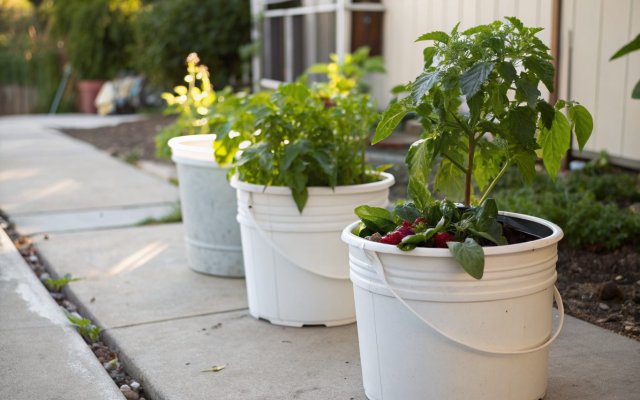
- Color. A dark bucket in full sun heats the root zone badly. White or pale buckets are better; if you only have dark ones, wrap them in burlap or stand them behind something.
Buckets are tall and narrow, so they dry out faster than a wide pot of the same volume. Expect to water every day in summer and mulch the surface.
How the ranking works
The crops below are ordered by how well they do in one standard bucket, taking into account yield for the space, how forgiving they are, and how much attention they need. The first dozen are easy and productive. The middle group works with a little care. The last few are on the list because people ask, and the answer is that they want more room than a bucket offers.
The 30
| # | Crop | Plants per bucket | Sun | Notes |
|---|---|---|---|---|
| 1 | Bush tomato | 1 | 6–8 h | Patio Princess, Bush Early Girl, Tumbling Tom. Stake once. The most rewarding bucket crop |
| 2 | Bush beans | 6–8 seeds | 6 h | Sow direct, pick every other day, done in six weeks. Sow a second bucket two weeks later |
| 3 | Swiss chard | 3 | 4–6 h | Crops for months; pick outer leaves. Tolerates shade and cold |
| 4 | Lettuce | 4–6 | 3–5 h | Loose-leaf types; cut-and-come-again. Shade in summer |
| 5 | Pepper | 1 | 6–8 h | Compact varieties; stake in wind. Warm spot, steady water |
| 6 | Kale | 1–2 | 4–6 h | Dwarf Blue Curled or Red Russian. Sweeter after frost |
| 7 | Bush cucumber | 1 | 6–8 h | Spacemaster or Bush Champion with a cage. Water daily |
| 8 | Potato | 1 seed potato | 6 h | Works, but a 10-gallon bag with three seed potatoes is far better value |
| 9 | Herbs, moist group | 3 | 4–6 h | Parsley, chives and basil share a bucket well |
| 10 | Herbs, dry group | 3 | 6 h | Thyme, oregano and sage share; add grit to the mix |
| 11 | Spinach | 6–8 | 3–5 h | Spring and fall only; bolts in summer heat |
| 12 | Scallions | 20+ | 4 h | Sow thickly, pull as needed. Nearly foolproof |
| 13 | Radish | 12–15 | 4 h | Ready in four weeks. Sow every two weeks |
| 14 | Arugula | 8–10 | 3–5 h | Fast, peppery, best in cool weather |
| 15 | Pak choi | 3 | 4 h | Six weeks from seedling; good fall crop |
| 16 | Carrot | 15–20 | 6 h | Short types: Paris Market, Thumbelina, Little Finger. Bucket is deep enough |
| 17 | Beet | 6–8 | 5 h | Thin to 4 inches. Eat the thinnings as greens |
| 18 | Garlic | 6–8 cloves | 6 h | Plant in fall, harvest in July. Needs the full bucket depth |
| 19 | Pea | 8–10 | 4–6 h | Dwarf types such as Tom Thumb; short support. Spring and fall |
| 20 | Eggplant | 1 | 6–8 h | Compact varieties such as Patio Baby or Fairy Tale. Needs heat |
| 21 | Cherry tomato, trailing | 1 | 6 h | Tumbling Tom over the rim of a bucket on a stand |
| 22 | Onion | 6–8 sets | 6 h | Bulbs are smaller than in a bed; scallions are the better bucket onion |
| 23 | Turnip | 6–8 | 5 h | Quick, easy, and the greens are good too |
| 24 | Broccoli | 1 | 6 h | Compact types such as De Cicco. One head then side shoots |
| 25 | Zucchini | 1 | 6–8 h | Bush types only. Better in 10 gallons; in a bucket, water twice daily |
| 26 | Sweet potato | 1 slip | 6–8 h | Beautiful vine, modest yield in a bucket; 15 gallons for a real crop |
| 27 | Winter squash, bush | 1 | 6–8 h | Bush Delicata or Honeynut in 10 gallons; a bucket gives one or two fruit |
| 28 | Cabbage | 1 | 6 h | Small varieties only; slow, and the bucket is full for months |
| 29 | Melon | 1 | 8 h | Compact types such as Minnesota Midget in 10 gallons; a single bucket rarely ripens fruit |
| 30 | Corn | 4–6 | 8 h | Needs a block of plants to pollinate; a bucket gives one or two small ears. Grow something else unless you have a dozen buckets |
The six that want two buckets
Some crops on the list simply need more root room than 5 gallons. Rather than buying bigger pots, two buckets can be made into one: cut the bottom out of one bucket, stack it on a drilled one, and fill both. That gives a 10-gallon container 28 inches deep, which suits potatoes, zucchini, bush squash, sweet potatoes, melons and a second plant of any big crop. A 10-gallon fabric grow bag does the same job and folds flat in winter.
Setting up a bucket
- Drill six to eight half-inch holes in the base, spread across it, not just in the center.
- Put an inch of coarse material in the bottom if you like; it is not essential, and a layer of landscape fabric over the holes keeps mix in without slowing drainage.
- Fill with potting mix to 2 inches below the rim, mixing in a handful of slow-release fertilizer.
- Water until it runs from the base, then plant.
- Put the bucket where it will stay. Full, it weighs 30 pounds or more.
- Mulch the surface with an inch of bark or straw to slow drying.
Stand buckets on bricks or pot feet so the holes drain freely. A bucket sitting flat on a balcony floor holds water in the base and the roots rot.
Watering and feeding
Buckets dry from the top and the sides, and in July a bucket of tomatoes can need water every day and sometimes twice. Check each morning with a finger an inch into the mix, and water until it runs out of the base. A self-watering conversion, using a second bucket as a reservoir with a wick between them, is a popular project that makes buckets far more forgiving.
Feed every one to two weeks from a month after planting, using a balanced liquid feed for leafy crops and a tomato feed for anything that fruits.
Making buckets look better
A row of orange buckets is not beautiful. Pale buckets look better and stay cooler. Wrapping them in burlap or standing them inside a slightly larger basket changes the look entirely, and a board along the front of a row hides them. Paint sticks to HDPE badly, so wrapping beats painting. After a season, most people stop noticing them.
Worth knowing
The crops at the bottom of the list are there because the question comes up so often, and the answer is that they want more room than a bucket gives. Corn pollinates by wind across a block of plants, melons want a long, hot season and a lot of root, and a cabbage fills a bucket for four months to give one head. If you have five buckets, tomatoes, beans, chard, lettuce and peppers will feed you far better than any of those.
Common questions
Are 5-gallon buckets safe for growing food?
Food-grade buckets are. Look for recycling code 2 or 5, and use buckets that held food rather than chemicals. Bakeries, delis and restaurants often have them for free.
How many holes should I drill?
Six to eight half-inch holes across the base. Fewer holes drain too slowly; holes in the sides near the bottom are a useful extra in very wet climates.
Do I need rocks in the bottom of the bucket?
No. A layer of gravel does not improve drainage and takes up room. A piece of landscape fabric over the holes stops mix washing out and is all you need.
How much potting mix does a bucket take?
About 0.7 cubic feet, so a 1.5 cubic foot bag fills two buckets. Leave 2 inches at the top for watering and mulch.
Can I grow tomatoes in a bucket?
Yes, and they are the best bucket crop. Choose a bush (determinate) variety, one plant per bucket, stake it once, and water daily in summer. The tomato guide covers varieties and care.
Read next
All vegetables guides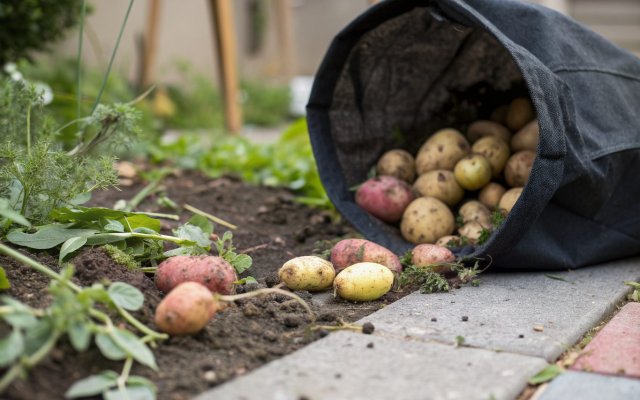

About the author
Carsten
Hi, I'm Carsten. My garden is paved over, so there is no soil to plant into and everything I grow lives in a container. I started this site to find out how much is possible that way, and I use it to share what I learn about choosing containers, growing useful plants in small spaces, and making gardening work for different homes and different bodies. Questions, corrections and photos of your pots are all welcome. say hello.