Crop guide · Vegetables
How to grow tomatoes in containers: bush varieties, 5 gallons and steady water
The variety you choose does more for a container tomato than anything else. Give a compact bush type at least five gallons of good potting mix and keep the water steady, and it will be one of the most rewarding things you grow in a small space.
- Container
- 5 gal min
- 7–10 gallons gives more root room
- Sun
- 6–8 hours
- Still fruits with less sun, just fewer
- Water
- Daily in heat
- Keeping it even prevents blossom-end rot
- First harvest
- 65–75 days
- Counted from transplant
Varieties that work: Patio Princess · Bush Early Girl · Roma (bush) · Tumbling Tom for baskets. Trickier in pots: Brandywine, Cherokee Purple and other indeterminate types (better in a bed).

Quick answer
Choose a determinate (bush) variety, plant it deep in a 5-gallon-or-larger pot of fresh potting mix rather than garden soil, put it somewhere with 6+ hours of sun, and water until it runs from the bottom every time the top inch dries. Feed every two weeks once the flowers open, and stop feeding in August. The rest of this guide fills in the detail.
Choosing a tomato variety for containers
Tomatoes come in two growth habits. Indeterminate plants keep growing until the frost. In open ground that gives you a six to eight foot vine cropping all summer, which is wonderful in a bed. In a pot the same plant outgrows its roots by July, wilts most afternoons, and sets only a little fruit for all the staking it needs. Determinate plants grow to a fixed size, usually two to four feet, set most of their fruit within three or four weeks, and then finish. That suits a container well, because the plant’s appetite matches the amount of soil it has.
Seed packets and nursery labels usually say which type a variety is. If a label doesn’t say, it is safest to assume indeterminate and pick something else for a pot.
Varieties that do well in pots
These are the varieties I keep coming back to. The yields are rough guidance for one plant in a 7-gallon pot, so expect a little less from a 5-gallon.
| Variety | Type | Height | Yield (7 gal) | Notes |
|---|---|---|---|---|
| Patio Princess | Determinate, hybrid | 24 in | ~3 lb | Bred for pots. Golf-ball fruit, sweet and early. |
| Bush Early Girl | Determinate, hybrid | 30 in | ~5 lb | Good flavor for very little work. Needs one stake. |
| Roma (bush types) | Determinate | 36 in | ~4 lb | The one for sauce. Watch the watering, as it is prone to blossom-end rot. |
| Tumbling Tom | Determinate, trailing | trails 18 in | ~2 lb | Hanging baskets and railing planters. Cherry-sized, generous. |
| Brandywine | Indeterminate | 6 ft+ | Not suited to pots | Wonderful in a bed, where it has the root room it needs. |
Container size
Start with at least five gallons for a compact bush tomato. Everything gets easier at seven gallons and better again at ten: the moisture stays more even, the plant builds more root, and you get more fruit. If you are choosing between one 10-gallon pot and two 5-gallon ones, I would take the single large pot.
- Fabric grow bags (7–10 gal) are my default. The roots air-prune at the edges, they never waterlog, and they fold flat for storage. They do dry out faster than plastic.
- Food-safe 5-gallon buckets work well once you drill six to eight drainage holes in the base. Dark buckets get very hot against a sunny wall, so paint them a light color or shade them.
- Self-watering planters suit tomatoes, which do best with even moisture. Expect to refill the reservoir daily in July all the same.
- Terracotta is lovely to look at, but it is heavy and wicks water out through its walls, so it suits herbs better than tomatoes.
Depth matters as much as volume. Plant the seedling deep, burying two-thirds of the stem. Tomatoes grow roots along any buried stem, and in a pot that extra root system is what keeps a plant standing on a hot afternoon.
Soil and feeding
Garden soil compacts into something like concrete in a container, so use a bagged potting mix. The potting soil guide explains what to look for on the bag. Add a handful of slow-release tomato feed at planting, and once the first flowers open switch to a liquid feed every two weeks. Stop feeding in August, because feeding this late mostly produces leaves and delays ripening.
How often to water
Most tomato trouble in a pot comes back to water, and specifically to water that is uneven. A pot that swings from bone dry to soaked gives you cracked fruit and blossom-end rot, the leathery black patch on the base of the fruit. That patch comes from the plant being unable to move calcium steadily while the moisture swings around, so the fix is the watering routine rather than eggshells or a calcium supplement.
The routine that works is simple. Each morning in summer, tip or lift the pot. If it feels light, water slowly until it runs from the bottom. If it feels heavy, leave it. By July that usually means watering every day, sometimes twice on the hottest ones. A two-inch mulch of straw or bark on the surface buys you a few hours either way.
Worth knowing
A potted tomato left unwatered for a couple of hot days will suffer, so if you are away in July it is worth asking someone to water or setting up a self-watering planter before you go. There is no way around it, but it is easy enough to plan for.
Support and pruning
A bush tomato needs one bamboo cane and two soft ties, and not much else. Leave the suckers alone: on a determinate plant every sucker carries future fruit, and the advice about pinching them out is written for indeterminate varieties in the ground. The only leaves worth removing are the ones touching the soil, which helps keep blight off the plant.
Common problems
| What you see | What it usually is | Fix |
|---|---|---|
| Wilting every afternoon, perks up at night | Pot too small or too hot | Shade the pot itself, mulch the surface, and move up a pot size next year |
| Black leathery patch on fruit bottom | Blossom-end rot from uneven watering | Water on a schedule. The affected fruit won’t recover, but the next ones will |
| Flowers drop without fruit | Nights above 75°F or below 55°F | Wait. Shake the plant at midday to help pollination |
| Lots of leaves, no flowers | Too much nitrogen | Stop feeding for three weeks, switch to a tomato (high-K) feed |
| Yellow lower leaves, brown spots spreading up | Early blight | Remove affected leaves, water the soil rather than the foliage, and improve airflow |
When to harvest
Pick when the fruit is fully colored but still firm, and twist rather than pull. A determinate variety gives you most of its crop within three or four weeks, so it is worth planning ahead to eat, freeze or cook it down. Once the plant is finished in late summer, pull it out, compost it, and sow lettuce in the same pot for fall.
Common questions
Can I grow tomatoes in a 3-gallon pot?
A trailing cherry type such as Tumbling Tom will give you a small crop in three gallons. A full-size bush variety in that much soil tends to wilt daily and fruit poorly, so five gallons is a much better starting point.
Do I need to hand-pollinate on a balcony?
Usually not, since wind and passing insects do the job. In an enclosed or very sheltered spot, tap the stake at midday while the flowers are open and that is enough.
Should I add eggshells for calcium?
They do little in the short term, as eggshells take years to break down. Blossom-end rot is nearly always about uneven watering, so steadying the watering routine is what helps.
Can I reuse the potting mix next year?
Not for tomatoes, because blight and wilt can overwinter in the mix. Use last year’s mix for flowers or herbs and start tomatoes in fresh.
Read next
All vegetables guides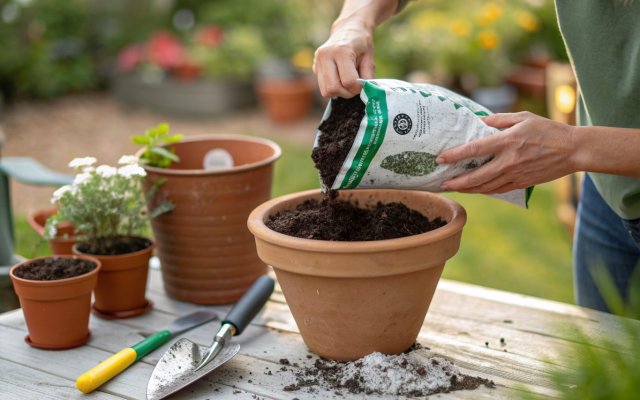

About the author
Carsten
Hi, I'm Carsten. My garden is paved over, so there is no soil to plant into and everything I grow lives in a container. I started this site to find out how much is possible that way, and I use it to share what I learn about choosing containers, growing useful plants in small spaces, and making gardening work for different homes and different bodies. Questions, corrections and photos of your pots are all welcome. say hello.